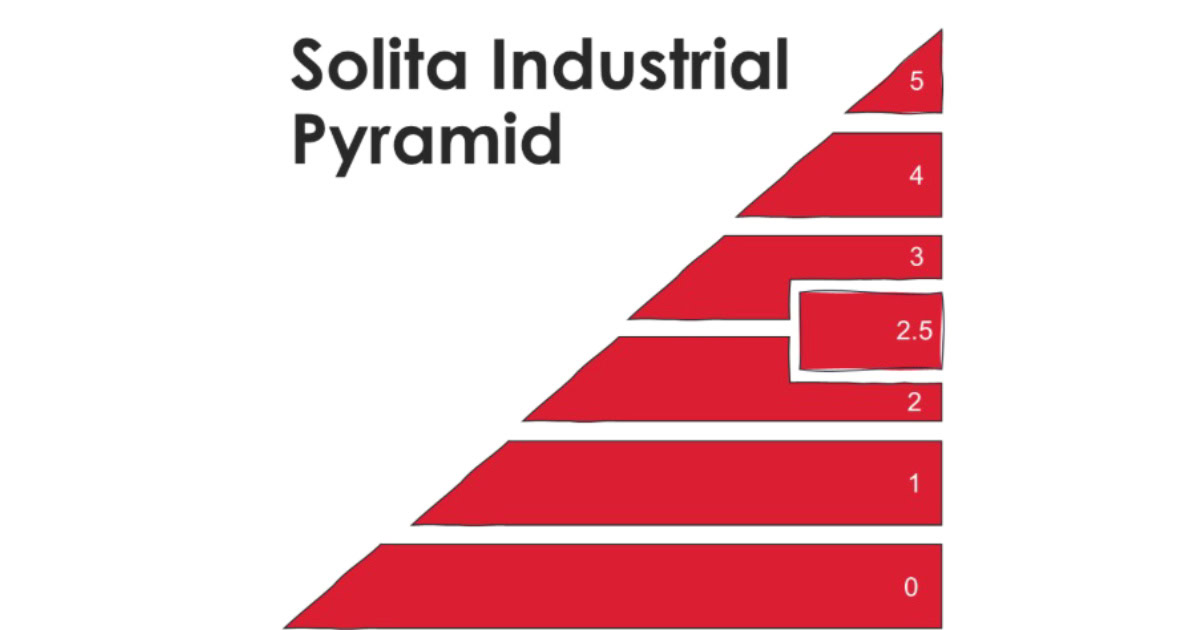
Figure 1. ERP, PLM, and MOM form the backbone of closed loop manufacturing at a digital enterprise.
ERP systems decide what to manufacture, PLM defines how to manufacture, and MOM (Manufacturing Operations Management, level 3) ensures that products are actually manufactured according to plan. Importantly, feedback flows both ways: MOM provides ERP and PLM with data about what has been produced, while ERP and PLM feed MOM with planning and design information. This creates a feedback loop where our fictional ACME manufacturing corporationcan adjust plans and product definitions based on actual production performance. Without this loop, late engineering changes may lead to production delays, inconsistent product definitions between plants, or unnecessary material and tooling costs.
Closing the loop between planning and production
The benefits of level 4 increase significantly when this closed loop is automated rather than handled through manual updates. Instead of relying on manual updates, systems communicate directly with one another, enabling information to flow seamlessly across the organisation.
When PLM publishes an engineering change, ERP automatically updates bills of materials and production plans, so that MOM can receive the new manufacturing instructions without delay. Similarly, as MOM detects a production deviation such as a machine outage or a quality issue, the information flows back instantly into ERP and PLM, triggering necessary schedule changes or even design adjustments.
At the same time, supply chain and procurement systems adapt automatically, ensuring that material flows remain aligned with the latest production plans. For ACME this automation means that the loop doesn’t merely exist in theory. The loop operates continuously, reducing manual effort and shortening reaction times between planning and execution.
From local optimisation to enterprise alignment
At the level of individual business units, the pressing need is to connect daily operations with planning. Level 3 delivers the operational truth, such as production schedules, equipment availability, quality results, and inventory levels. When integrated with the unit’s level 4 systems for ERP, PLM, or SCM, this allows managers to make informed, timely decisions, including adjusting schedules, reacting to quality deviations or balancing material constraints.
The challenge arises when each unit does this in isolation, as the reality has been for our fictional global company ACME. Shipbuilding, consumer goods, and chemicals divisions have started to optimise for their own realities and without shared standards, the data models, planning cycles, and KPIs have become fragmented. When ACME’s chemical division reports production efficiency, it calculates KPIs differently from the consumer goods division. As a result, group-level performance comparisons become lengthy reconciliation exercises rather than straightforward dashboards.
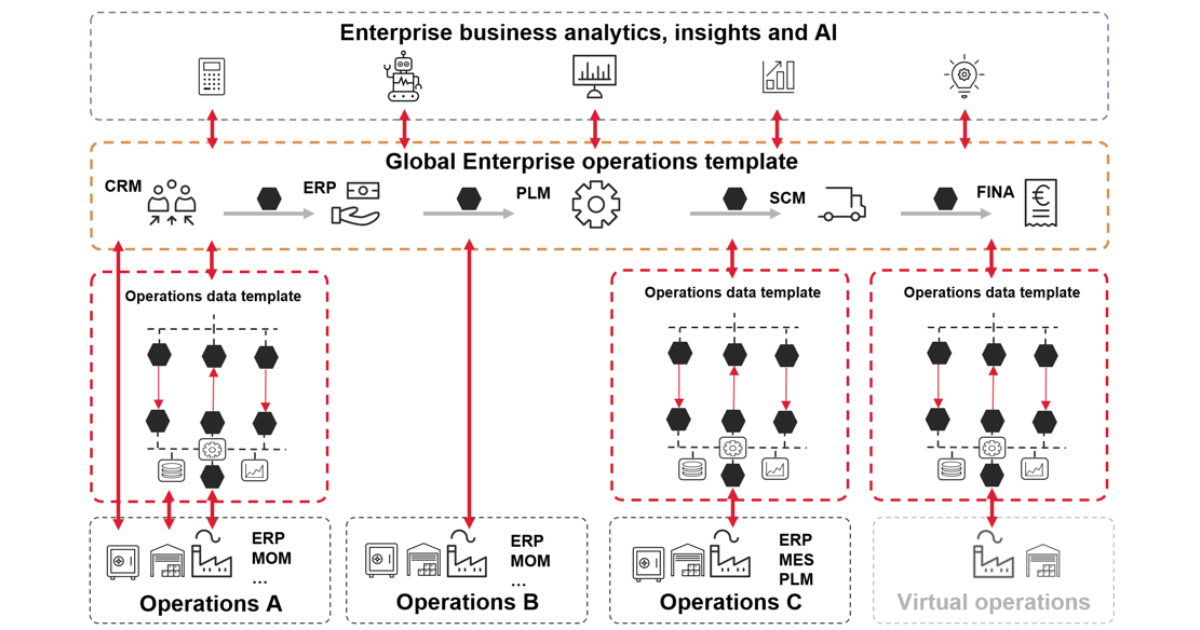
This is where federated business data governance comes into play. In a federated model, ACME’s business units retain ownership of the data they know best, from product structures to supplier details, while aligning with enterprise-wide standards for master data, reference data, and governance practices. This allows units to keep the agility they need locally, while still ensuring that critical elements such as raw material master data, financial structures, customer hierarchies and location information are consistent across the enterprise.
Figure 2. Shared enterprise and operations templates power federated data governance that enables connecting ERP planning with site operations and ecosystem analytics.
When ACME introduced shared data definitions and governance practices, operational data became comparable across business units and regions while units retained local control. A consistent enterprise-level reporting and planning structure across functions such as production, inventory management, capacity planning and demand balancing improves transparency, accelerates decision-making and strengthens resilience in a geopolitically complex environment.
These capabilities are enabled by scalable cloud platforms that bring enterprise applications and MOM data together into a unified digital backbone. Moving Level 4 to the cloud supports global scalability, advanced analytics and scenario planning, while allowing standardised core data structures and locally configured processes, including deployment across both EU and non-EU service locations.
In short
At level 4, enterprise planning systems translate strategic goals into concrete production plans, sourcing decisions and financial commitments. Without this translation, strategy risks remaining disconnected from operational reality. To deliver on its promise, it must connect unit-level realities from levels 3 and 4, federated governance of business data, automation of the closed loop, and modern cloud platforms. Only then can ACME move from fragmented planning to holistic, enterprise-wide business execution.
How we support level 4 transformation?
When ACME looks for a partner to solve its level 4 challenges, the real question isn’t only who can deliver an ERP project or who can build a data warehouse. The question is: who can help us connect the entire chain from shop-floor operations through enterprise planning to business design and automate it into a closed loop?
This is where Solita, as an experienced integration and transformation partner, becomes essential. We work across factory-level data, enterprise planning systems and business architecture to ensure these layers function together. Traditional monolithic systems with 20+ year lifespans are no longer viable. Modern enterprises need flexible architectures that not only manage internal functions but also connect seamlessly to partners, customers, and ecosystems.
We help clients combine core business applications with modern data, cloud, and integration capabilities to create this flexibility. By separating data and integration layers from rigid legacy platforms, organisations can evolve their systems without large-scale replacements. And because technology alone is never enough, we also support the human side of transformation by guiding organisations through change management, helping business units adopt new ways of working, and ensuring that digitalisation initiatives deliver their intended value.
Our broad portfolio spanning design, data, cloud, integrations, software development, enterprise architecture and transformation services enables PLM, ERP and MOM to operate as a unified, real-time digital core. Powered by Solita FunctionAI, enriched with advanced analytics, machine learning and Generative AI agents, Level 4 evolves from a set of disconnected systems into an intelligent, self-optimising loop. Changes in design, production or demand are continuously interpreted by AI-driven workflows and autonomous agents, automatically synchronising planning and logistics. This allows management to move beyond manual coordination and focus on growth, innovation and strategic value creation.
Examples from industrial environments
These approaches have been implemented in real industrial environments. At Solita, we have brought it to life together with leading industrial companies in real operating environments.
With Ponsse, the journey began by rethinking how data moves between the factory floor and enterprise systems. Together, we built a cloud-based data platform and modernised their manufacturing execution systems, tightening the loop between shop-floor operations and enterprise planning. As visibility improved, flexibility followed. What once required manual coordination became increasingly automated, extending all the way from forecasting to predictive maintenance.
At Outokumpu, the story centered on unlocking the full value of data across global operations. We built a global cloud-based data platform that made data accessible, governed, and reusable at scale. Instead of siloed information, Outokumpu gained a shared, reliable foundation for decision-making. This enabled faster responses, supported AI-driven innovation, and allowed teams to create reusable data products that strengthened both efficiency and competitiveness.
For SSAB, the challenge was scale and consistency. As business units evolved, they needed a shared direction. Together, we defined a cloud strategy and governance model that provided a common vision and uniform operating practices. This became the backbone for scaling level 4 automation across the enterprise, ensuring that growth didn’t come at the cost of alignment.
YIT’s transformation unfolded over several years. In close collaboration, we co-created a unified data platform with master data management, governance, and cloud architecture at its core. This end-to-end foundation turned data into a strategic asset. It ensured that execution at the unit level consistently aligned with the broader enterprise-level data & AI strategy that we also helped to shape alongside YIT’s leadership.
With EVBox, the impact was immediate and tangible. By consolidating financial, product, and IoT data into a modern data platform, analysis times were reduced from hours to minutes. What changed was not only speed, but also agility. Business leaders gained the ability to act on insights almost instantly, demonstrating how level 4 automation directly translates into sharper, faster decision-making.
Beyond customer engagements, we continuously invest in building future-ready capabilities ourselves. Our Industrial Data Hothouse brings together data engineering, cloud, OT/IT integration, and advanced analytics to explore new ways of turning operational data into actionable insight. For ACME, this means we are delivering solutions for today and actively preparing for the challenges and opportunities of tomorrow.
What the future looks like for level 4 and beyond?
For ACME, mastering level 4 today is about breaking down silos, connecting ERP, PLM, SCM, and MOM, and automating the closed loop between strategy and execution. But the real question is: what comes next? The next stage of level 4 development extends beyond efficiency to include resilience and adaptability in volatile industrial environments. And ultimately, it’s about preparing the ground for the next stage of evolution, level 5.
Industrial companies are operating in an environment that is more volatile than ever. Supply chains are disrupted by geopolitical shifts, raw material markets fluctuate unpredictably, and sustainability regulations are tightening across regions. At the same time, customers expect faster delivery, greater transparency, and more tailored services. Traditional level 4 planning processes based on fixed cycles and manual reconciliation simply cannot keep up. Without new approaches, strategy will always lag behind reality. The next wave of level 4 innovation is therefore essential for staying competitive, not optional.
In most organisations, planning has traditionally followed fixed cycles such as monthly forecasts, quarterly reviews and annual budgeting. The future of Level 4 complements this rhythm with continuous optimisation enabled by real-time data integration and automation. Demand and supply balancing, resource allocation and buffering decisions can be refined continuously rather than only at predefined intervals. Small deviations between forecast and actual demand, capacity utilisation or material availability become visible earlier and can be corrected systematically. Over time, this steady fine-tuning reduces hidden inefficiencies and strengthens the alignment between planning and day-to-day execution.
As level 4 evolves, automation becomes increasingly intelligent and context-aware. Artificial intelligence and machine learning move to the centre of decision-making, providing predictive insights and prescriptive recommendations. ACME can forecast demand spikes, optimise inventory across complex projects, or simulate the impact of raw material shortages with far greater precision than before.
Beyond analytics alone, this intelligence can be embedded into AI-driven playbooks for managers. Instead of simply presenting data, the system can recommend concrete actions based on predefined business rules and learned patterns, for example, suggesting alternative suppliers when risk indicators rise, proposing production reallocations when capacity constraints emerge or outlining cost–service trade-offs under different demand scenarios. Managers remain in control, but they are supported by structured, data-backed guidance that accelerates and strengthens decision-making.
How automation at level 4 becomes increasingly intelligent
This intelligence is only as strong as the data foundation beneath it. By contextualising data and mapping products, equipment hierarchies, assets and production processes into shared models, the organisation ensures that dashboards, planning tools and AI applications reflect how work actually happens instead of how systems happen to store it.
The real value of this foundation lies in improving daily operational processes. In many organisations, production, product structures, sales forecasts, procurement decisions and maintenance activities are still examined as separate dimensions. Each may be optimised locally, yet significant value remains untapped in the gaps between them. When these perspectives are connected through a shared data model, trade-offs become visible: how a product design choice affects changeover time, how a sales campaign influences line stability, or how procurement decisions impact quality and throughput.
On top of this connected foundation, digital twins and simulation tools become practical instruments for daily decision-making. They help evaluate sequencing choices, capacity allocations, material substitutions and parameter adjustments before changes are made on the shop floor. Strategy and operations move closer together because everyday decisions are made with a clearer understanding of their operational consequences.
In this way, level 4 evolves from rule-based automation into data-driven and increasingly predictive decision support. As we describe in From data storytelling to knowledge storytelling: The missing visualisation layer in the AI era, the key shift is not about adding more dashboards, but about moving from showing what is happening to clarifying why it matters. By making relationships, dependencies and operational context visible, level 4 links signals directly to business consequences. It becomes a true decision layer, where predictive insight is built on shared understanding rather than isolated observations.
From enterprise optimisation to ecosystem value: The rise of level 5
As level 4 matures into a real-time decision hub, optimisation inevitably extends beyond the enterprise. The traditional ISA-95 pyramid has focused on aligning systems and processes within company boundaries. Level 5 shifts that perspective outward. For ACME, collaboration with suppliers and customers is not new. Forecasts are shared, data is productised and information already crosses organisational borders. What changes at level 5 is not whether data is exchanged, but how: data sharing evolves from isolated integrations into structured, governed ecosystems.
When value depends on multiple actors operating on a shared digital foundation, common infrastructure becomes strategic. Harmonised data models, secure exchange mechanisms and agreed governance rules turn bilateral interfaces into scalable capabilities. Data spaces and unified namespaces provide a common language for assets, processes and transactions, allowing partners with very different levels of digital maturity to participate without rebuilding their internal systems. Instead of enforcing uniform technologies, ACME defines what must be exchanged and under which rules, not how each partner structures its internal environment.
In this model, suppliers expose agreed datasets such as forecasts, quality indicators, and traceability information while retaining control over sensitive details. ACME combines this with its own operational intelligence to improve planning accuracy, manage supply risks and strengthen sustainability reporting. Ecosystem value no longer emerges from ad-hoc integrations, but from shared rules and interoperable foundations. And this is where level 4 proves essential: automation, contextualisation, AI and governance are not only tools for enterprise optimisation, but prerequisites for meaningful ecosystem participation. With harmonised internal data, level 5 becomes not an aspiration, but a competitive capability.
Strategic implications
For industrial leaders, level 4 is becoming a strategic inflection point. It is no longer merely the layer where plans are converted into schedules and budgets, but the environment where data, automation and business intent merge into continuous decision-making. Organisations that understand this shift treat level 4 not as a system enhancement, but as a redesign of how strategy is executed in real time and increasingly across organisational boundaries.
As discussed in The leadership paradox – Leading beyond expertise in the age of AI, an advantage in the AI-driven era stems less from deep individual expertise and more from the ability to orchestrate technology, data and people toward shared goals. Investing in automation, data governance, contextualised models and scalable cloud platforms is therefore a strategic leadership decision. Those who deliberately strengthen their level 4 capabilities today are building the foundation for AI-augmented operations and future ecosystem-based value creation.
Supporting the journey toward level 5
At Solita, we are already helping companies take these steps. By combining deep expertise in data, cloud, OT/IT integration, and AI with a factory-to-boardroom perspective, we support organisations like ACME in turning change into lasting competitive advantage. The future of level 4 is not only about doing the same things better, but about enabling entirely new ways of creating value. First within the enterprise, and then across entire ecosystems.
Check out also my previous posts: