
Building AI solutions for real problems
I’m an AI Engineer at Solita, working in the AI Office and building FunctionAI, an agentic AI engine platform used by our employees and it’s also something we offer to our customers. Instead of a single application, FunctionAI provides a foundation for building tailored AI solutions to meet different needs, from knowledge assistants to integrated applications and workflows.
My background is in software engineering, with a strong focus on backend development. I’ve worked across startups, consulting, and product companies, building full-stack applications and backend services within larger microservice platforms. Since joining Solita, I’ve expanded into the AI engineering field, through the development of FunctionAI.
In my current role, I focus on building reliable, cost-effective AI systems. I develop flexible agentic workflows that can adapt to each task, for example, generating a straightforward response or following a more involved process in which agents plan, use tools, review their work, and pause for human input when needed. I also work on securely integrating external tools through MCP and improving how information is retrieved and brought into the model’s context. The platform uses an LLM gateway which gives us flexibility to choose different models while balancing performance and cost. Because AI outputs can vary, evaluating these systems means looking beyond traditional tests in order to assess retrieval, response quality, and reliability under real workloads.
At the same time, the technical work is closely connected to understanding what people really need. I work with different stakeholders across Solita to understand their day-to-day work, where the friction points are, and where AI could make things easier.
Making AI useful, reusable, and secure
It’s still early, but we’re already seeing a shift: people can spend less time on repetitive tasks and more time making decisions, and using their judgment. The important thing is to do that thoughtfully by letting AI handle the work it’s well suited for, while keeping people involved in the decisions that matter, rather than just asking them to approve the result.
The platform is also designed to be reusable. Since different applications can be built on top of it, other teams won’t always have to start from scratch when they want to build an AI solution. They can use the platform as a foundation and accelerator, making it easier to experiment and develop solutions for different needs.
Security is a big part of this too. Customers care a lot about data security and EU data residency, and those questions come up often once we talk about how the platform would actually be used. My role has mostly been on the technical side of those conversations, helping the customer-facing teams with questions like where data lives, how it’s handled, and what the architecture actually guarantees.
We’re still in a transition period where companies are figuring out how AI fits into their work. For me, it’s interesting to be part of that process and help find ways of making AI adoption secure, efficient, and genuinely useful.
Learning AI by building it
One of the biggest areas of growth for me since joining Solita has been moving from traditional software development into AI development. Shortly after I started, I completed an AI certification, which gave me a good foundation and a deeper understanding of how AI actually works. Then, working on this project gave me the opportunity to start building AI systems in practice.
That combination has mattered a lot. Building things alongside the theory has taught me what works in practice, not just in principle. AI engineering already has plenty of named patterns, such as RAG, agent loops, and fan-out pipelines, much like traditional software. The difference comes after choosing a pattern: because AI systems are non-deterministic, you need to test them against real outputs, make adjustments, and see whether they hold up for the problem you’re trying to solve.
Alongside my project work, I contribute to knowledge sharing across Solita. Since there are only two of us in Sweden working directly on the project, colleagues often turn to us with questions. I’m also involved in wider AI enablement efforts, helping people understand both how to use AI effectively and responsibly, and how to get the most out of the FunctionAI platform.
A culture of trust and curiosity
Before joining Solita, I had heard good things about the people and the culture. Now I would say that the reality has matched that impression. One thing I’ve particularly appreciated is the level of trust. You’re trusted to take ownership, and there is an expectation that you can grow into your role rather than needing to know everything from the beginning.
I also enjoy the fact that people are interested in what others are working on. Since consultants are usually working on different projects, there is a wide range of experiences and ideas to share. It’s great to talk about what we’re working on and hear how others approach things.
I don’t think we talk about Solita’s values all the time, but I can recognise them in everyday work. People care about each other, but they also care about the work they do and the quality of what they deliver. People are approachable and easy-going, and there is a lot of passion for technology and solving problems.
I saw that particularly clearly during the AI hackathon we organised earlier this year. People were really excited about being together, building something, and then showing what they had created. The event brought out a lot of technical curiosity and enthusiasm, and it was great to be part of it.
Curiosity, adaptability, and problem-solving
For me, having a growth mindset is important.
Technology is changing quickly, and AI is probably one of the fastest-moving areas I’ve worked with. You can’t expect to know everything, and nobody does, so being curious, asking questions, and wanting to keep learning matters a lot.
Adaptability matters just as much in consulting. You move between different projects, teams, customers, and domains, so being comfortable with change isn’t optional. The other half of that is being able to break things down: often you’re not handed a clearly defined problem with a solution waiting at the end of it. You have to work out what’s actually being asked, split it into pieces you can act on, and then figure out what kind of solution fits.
I saw that same mindset outside the technical work, during a sailing activity at our team day in Sweden. Most of us had never sailed before, and just as it was our team’s turn, the rain started pouring. We were soaked and figuring things out as we went, but everyone got involved and worked together. It was fun to see how quickly we pulled together and made the best of it.
Finding balance outside the screen
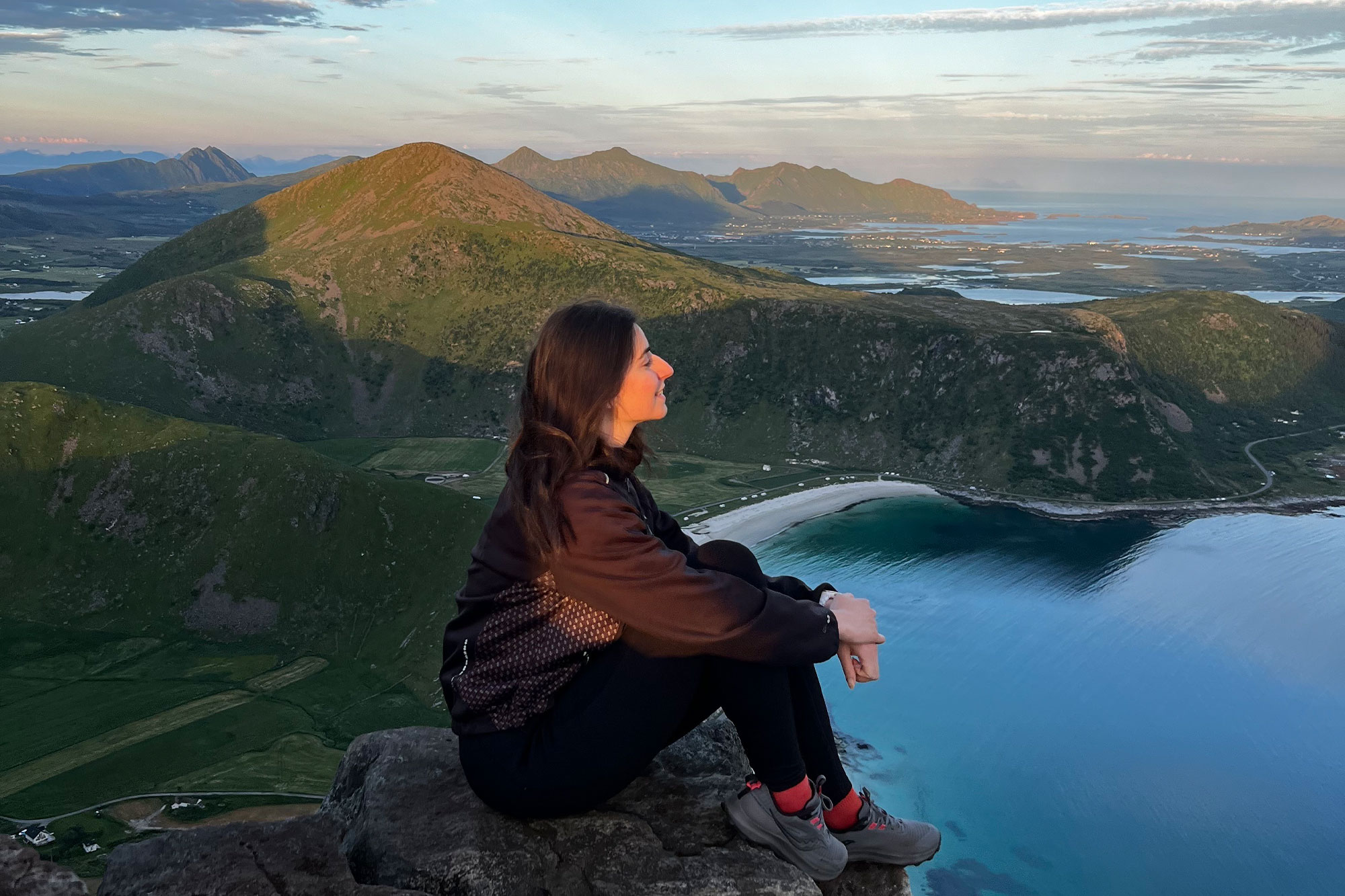
Outside work, I like spending time in the forest. Walking among the trees helps me switch off and enjoy the quiet, and it’s often when my best ideas come to me. I’ve done some long-distance hiking and would love to hike in Norway again, but even a walk in the woods close to home helps me reset.
I’ve also recently started painting, mostly flowers, and I enjoy trying something new. Once I start, three hours can fly by. Everything else seems to go quiet, and it’s just me, the canvas, and the image I’m trying to create. One of my favourite paintings shows a coffee machine pouring coffee into a cup beside a vase of flowers. It brings together two things I love, painted in bright, unexpected colours. I joke that my home is becoming an art gallery.
Interested in working at Solita? See our open positions and subscribe to our talent community newsletter.