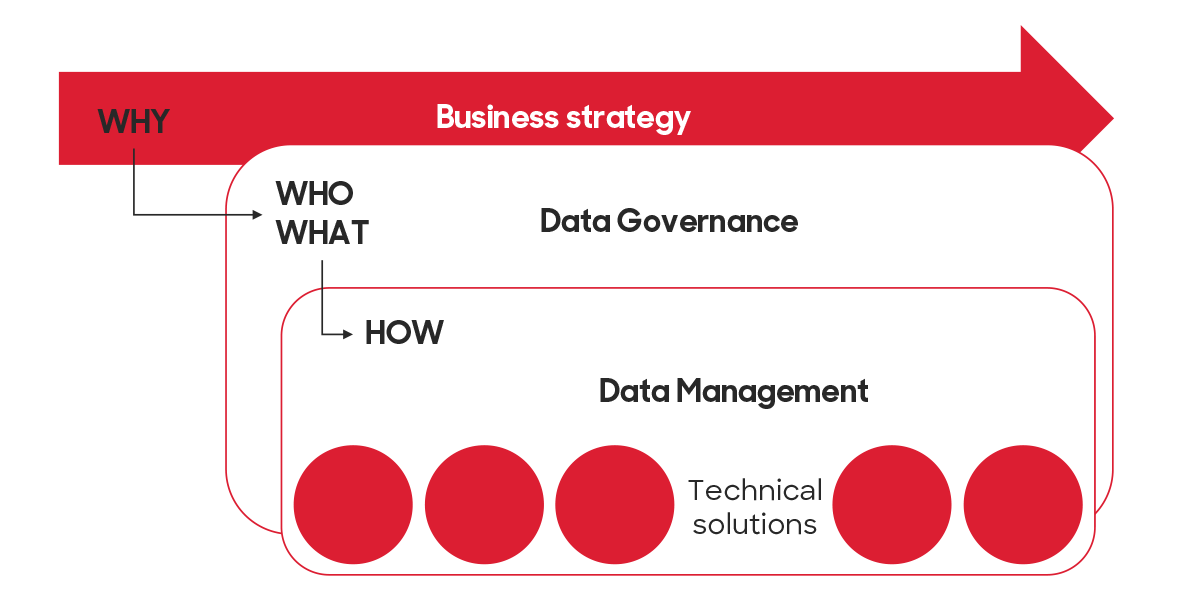
Data governance is the strategic framework of policies, processes, roles, standards and metrics that ensure an organisation manages its data as a valuable enterprise asset.
This blog post provides expert guidance on establishing data governance frameworks that scale with your organisation. Whether you’re just starting your governance journey or looking to mature existing practices, you’ll find actionable insights grounded in real-world implementation experience. Let’s start with the basics.
What is data governance?
Data governance is the set of rules and practices that control who can access, manage, and use data to maintain its quality and security. It establishes clear accountability for data quality, security, privacy, and usage while enabling authorised users to access and utilise data effectively.
At its core, data governance answers critical questions that plague every data-driven organisation: Who owns this data? Who can access it and under what circumstances? How do we ensure it’s accurate and reliable? What happens when things go wrong? Where did this data come from, and where is it going? These questions become exponentially more complex as organisations grow, adopt new technologies, and face increasing regulatory scrutiny.
Data governance is often confused with related concepts. Data governance sets the strategy and policies: “what” and “why.”
Data management implements those policies through processes and technology: “how.”
Data operations execute day-to-day tasks like backups, monitoring, and issue resolution.
Think of governance as the legislative branch defining laws, management as the executive branch implementing those laws, and operations as the day-to-day work of running government services. All three layers are essential, but governance provides the strategic direction.
Business case for data governance
Organisations implement data governance to solve concrete business problems, not to check compliance boxes. According to Gartner, poor data quality costs organisations .9 million annually. Regulatory penalties for data breaches and privacy violations reach hundreds of millions. Analytics and AI projects fail when teams can’t find trustworthy data or waste months reconciling inconsistent definitions across systems.
Effective data governance transforms these challenges into competitive advantages. Organisations with mature governance capabilities make faster decisions based on trusted data. They accelerate time-to-market for analytics and AI initiatives because data scientists spend less time cleaning data and more time building models. They reduce operational costs by eliminating duplicate data management efforts across teams. They innovate confidently knowing they can demonstrate compliance and manage risk.
The balance of control and enablement
The most common governance failure is being too restrictive. Organisations implement heavy-handed policies that slow down legitimate work, leading teams to create shadow IT systems and circumvent governance entirely. Effective governance balances protection with enablement. It makes doing the right thing easier than working around the rules.
This balance requires understanding organisational culture. A hierarchical organisation with low risk tolerance will implement different governance than a fast-moving startup. Neither approach is inherently better; governance must fit the organisation’s reality to succeed.
Modern data governance also recognises that perfect centralised control is neither possible nor desirable in distributed architectures. Organisations adopt federated models where domain teams own their data while complying with global standards for security, privacy, quality, and interoperability. This approach, exemplified by the data mesh paradigm, acknowledges that the people closest to data creation and usage are best positioned to govern it—with appropriate guardrails.
What are the components of a data governance framework?
A comprehensive data governance framework comprises interconnected components that work together to manage data as a strategic asset. Understanding these building blocks helps organisations design frameworks tailored to their needs rather than adopting one-size-fits-all approaches.
Data governance operating model
The operating model defines who makes decisions about data and how those decisions get made. Without clear accountability, data governance becomes “everyone’s responsibility” which in practice means no one’s responsibility.
- The data governance council or the steering committee provides executive oversight, sets strategic direction, allocates resources, and resolves cross-domain conflicts. Membership typically includes senior business leaders, IT leadership, legal, compliance, and risk management representatives. The council meets quarterly or monthly to review progress, approve major policy changes, and ensure alignment with business strategy.
- Chief Data Officer (CDO) or equivalent leads the governance program, chairs the governance council, and serves as the executive champion. The CDO role has evolved from compliance-focused positions to strategic leaders who drive business value from data assets.
- Data Owners are business leaders accountable for specific data domains—customer data, product data, financial data, operational data. Ownership means making decisions about access, quality standards, retention, and acceptable use for their domain. Critically, data owners must have both accountability and authority, including influence over budget and technology decisions affecting their data.
- Data Stewards implement governance policies day-to-day within domains. They define business rules, resolve data quality issues, document metadata, manage master data, and serve as subject matter experts. Stewards bridge business and technical teams, translating business requirements into technical implementations.
- Data Custodians manage the technical infrastructure—databases, storage systems, integration platforms. They implement security controls, perform backups, optimise performance, and execute steward-defined quality rules.
- Domain Subject Matter Experts provide specialised knowledge about data within their areas: what it means, how it’s used, what quality looks like, what regulations apply.
Policies and procedures
Policies establish rules and principles for data management across the organisation. Effective policies are clear, actionable, and enforced consistently.
- Data classification policies categorise data by sensitivity level (public, internal, confidential, restricted) with corresponding handling requirements. Classification drives access controls, encryption requirements, storage locations, and sharing restrictions.
- Data quality standards define expectations for completeness, accuracy, consistency, timeliness, validity, and uniqueness. Standards specify acceptable quality thresholds—for example, customer email addresses must be 99% valid, product prices must reconcile within 24 hours of updates.
- Data access and security policies govern who can access what data under which circumstances. This includes authentication requirements, role-based access control (RBAC) models, privileged access management, and access certification processes. Security policies also cover encryption standards, data masking requirements, and secure data sharing protocols.
- Data privacy policies ensure compliance with regulations like GDPR, CCPA, and industry-specific privacy laws. They address consent management, personal data processing, data subject rights (access, deletion, portability), and cross-border data transfers.
- Data retention and archival policies specify how long different data types must be kept for business or regulatory purposes and when data should be archived or deleted. These policies balance compliance obligations, business needs, and storage costs.
- Data lifecycle management procedures document processes for data creation, storage, usage, archival, and deletion. Procedures provide step-by-step guidance for common governance activities like requesting data access, reporting quality issues, or onboarding new data sources.
Data catalog and metadata management
Metadata (data about data) is the foundation that makes governance operational. A data catalog provides a searchable inventory of data assets with rich business and technical context.
- Business metadata includes business names and definitions, glossary terms, data ownership assignments, domain classifications, and usage guidelines. This context helps users understand what data means and how to use it appropriately.
- Technical metadata captures system names, database schemas, table and column definitions, data types, primary and foreign keys, indexes, and storage locations. Technical metadata enables IT teams to manage and integrate data assets.
- Operational metadata tracks when data was last updated, update frequency, processing logs, job run status, and data volumes. This metadata supports monitoring, troubleshooting, and capacity planning.
- Data lineage shows where data originates, how it transforms as it moves through systems, and where it’s ultimately consumed. Lineage enables impact analysis (what downstream systems are affected if we change this field?), root cause analysis (why is this report showing unexpected values?), and compliance reporting (can we demonstrate where personal data flows?).
- Data profiling and quality metrics provide statistical summaries; row counts, null percentages, distinct value counts, value distributions, and pattern analysis. Quality metrics track conformance to standards over time, highlighting degradation trends.
Data quality management
Data quality management establishes systematic processes to measure, monitor, and improve data quality continuously.
- Data quality dimensions provide a framework for assessment: completeness, accuracy, consistency, timeliness, validity, and uniqueness.
- Quality rules and validation define automated checks applied to data. Rules range from simple (email addresses must contain ‘@’) to complex (order total must equal sum of line items plus tax minus discounts). Rules are documented, versioned, and applied consistently.
- Data quality dashboards and scorecards provide visibility into quality status across domains and systems. Scorecards track metrics against defined targets, making quality transparent to business and technical stakeholders.
- Issue detection and remediation workflows formalise how quality problems are identified, assigned, tracked, and resolved. Workflows ensure issues don’t fall through cracks and provide audit trails for compliance.
Master data management
MDM creates and maintains a single, authoritative reference data for critical business entities (customers, products, suppliers, employees, locations, assets). MDM prevents the “which is the correct customer record?” problem that plagues analytics and operations.
MDM approaches vary: registry-style (metadata about where golden records live), consolidation-style (physical golden records stored centrally), coexistence-style (synchronised records across multiple systems), or centralised (single system of record). The right approach depends on organisational needs, technical constraints, and tolerance for complexity.
Governance frameworks must account for how data moves through technical architectures. This includes defining integration patterns, data sharing mechanisms, API standards, event streaming protocols, and data product specifications in modern architectures like data mesh.
Frequently asked questions about data governance
- What’s the difference between data governance and data management? Data governance establishes the strategy, policies, and decision rights for data as an enterprise asset. Data management implements governance policies through processes and technology. Governance decides what data quality standards should be; management implements quality monitoring and remediation processes.
- How long does it take to implement data governance? Initial governance foundations typically take 3-6 months. Operationalisation and broader adoption require 6-12 months. However, governance is continuous, not a one-time project. Organisations should plan for ongoing investment in governance evolution and improvement.
- Do we need a Chief Data Officer to implement governance? A senior executive is essential, but the specific title matters less than their authority and commitment. CDOs, CAOs (Chief Analytics Officers), or senior business leaders can effectively sponsor governance. The sponsor must have organisational credibility, decision-making authority, and sufficient priority to dedicate time to governance leadership.
- Can small organisations implement effective governance? Yes, but appropriate for their scale. Small organisations need simplified governance: clear data ownership, basic classification and access policies, and lightweight processes. Focus on highest-priority risks and enablers, using simple tools and processes.
Let’s discuss how we can help you transform data governance from a compliance obligation into a competitive advantage.
Interested for more? Read my next post: How to build a data governance framework.