
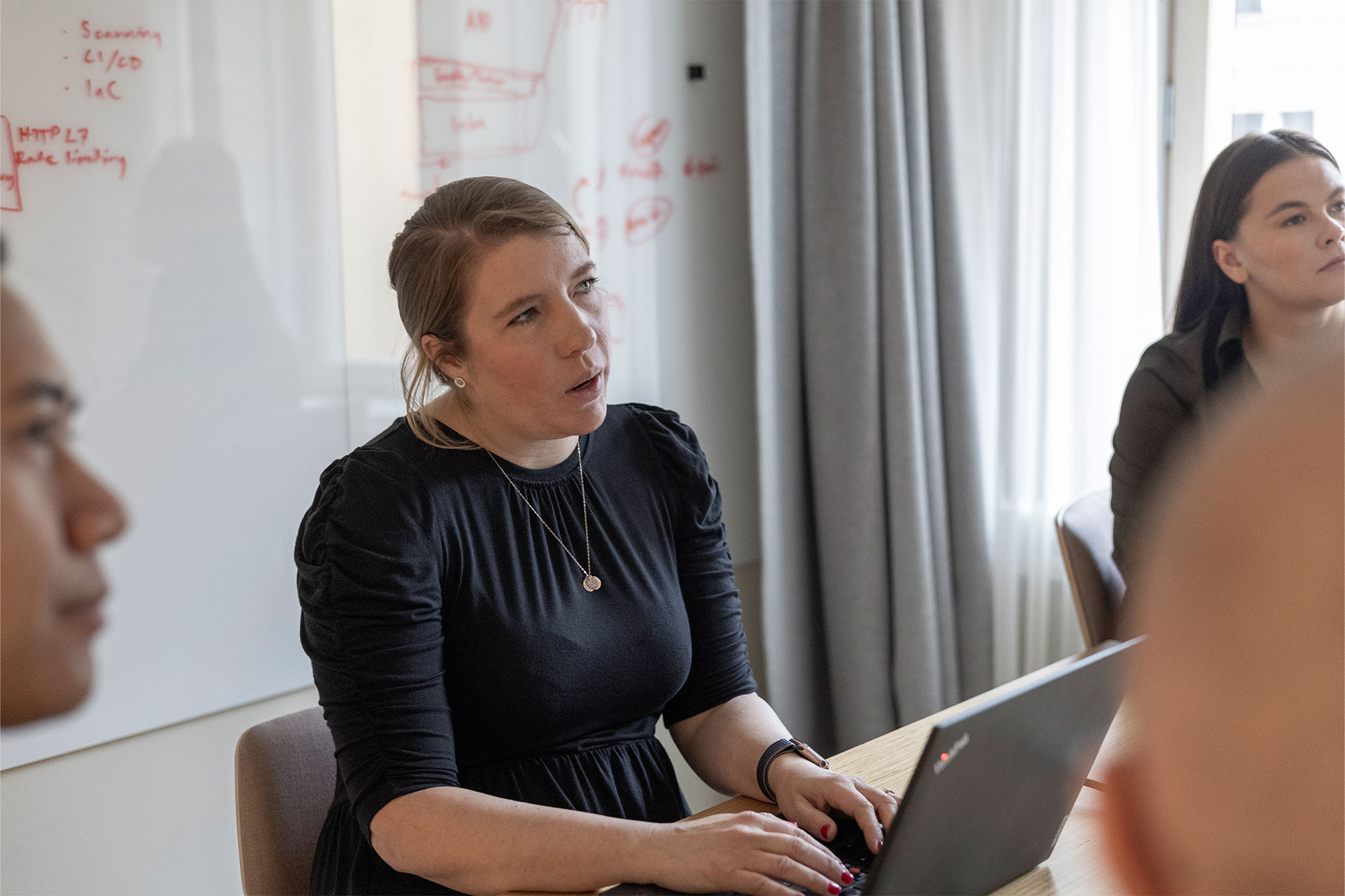
This changes how collaboration happens between design and technology. The boundaries between roles are becoming more fluid, and conversations that used to happen through documents or presentations now often happen directly through prototypes or early working software that the team can explore together.
Based on our experiences across different projects, this blog explores how AI is reshaping the collaboration between design and technology, what it enables in practice, and what still requires human judgment.
Design as a bridge between perspectives
At Solita, design has never been only about interfaces or visual appearance. Design is closely connected to the value a solution creates for users and for the business.
When designing digital services, we often use the classic framework of desirability, feasibility, and viability. A solution needs to create value for its users, be something the organisation can credibly build, and be valuable for the business.
Design often sits in the middle, bridging different perspectives. Our work involves understanding users, the realities of the client organisation, and the technical constraints of the systems being built. AI tools help us explore ideas faster, but they don’t remove the need to define the problem we are solving.
In many projects, the most valuable design work still happens before anything is built. When creating solutions becomes easier, defining the right problem becomes even more important.
Faster building changes where the real work happens
One of the biggest shifts AI brings is speed. With AI-assisted tools, teams can explore multiple approaches in a fraction of the time it used to take, and accelerate existing processes significantly.
But speed is only part of the story. When AI is introduced into an existing process, it may accelerate one part of it, only to expose or create bottlenecks elsewhere. For example, in an insurance claims process with a manual review stage that takes a fixed amount of time, speeding up everything before it doesn’t help unless the entire process structure changes. An AI-native way of doing something can look completely different: the process needs to be reorganised, parts of it parallelised, and it may end up composed of tasks that didn’t exist in the original flow at all.
This is exactly what’s happening at the intersection of design and development, too. AI accelerates design and building, but not organisational decision-making. Decision-making structures have traditionally assumed that software development is slow and design is fast. When that assumption flips, the methodologies, frameworks, and decision-making processes around application development need to be rethought as well. Without intentional change, the speed of AI may not translate into organisational value, but rather into someone getting longer lunch breaks.
Speed requires clarity and direction
As building becomes faster, core design capabilities become more important. Clear problem definition, stakeholder collaboration, and a deep understanding of real user needs are critical. Many ideas are now technically possible to implement. The harder question is which ones are actually worth pursuing. More possibilities don’t mean they should all be built.
When ideas quickly turn into something tangible and interactable, it can make it harder to question underlying assumptions. This can lead to polishing what exists instead of asking whether it solves the right problem. That’s why, in a time of speed, it is crucial for the team to pause and ask: Should we build this, and what evidence supports it?
AI is bringing designers and developers closer
AI tools are changing how designers and developers work together. Developers can generate user interfaces. Designers can more easily create prototypes that behave more like real apps or contribute directly to software development.
This doesn’t mean the roles become the same, but it lowers the barrier between them. Instead of handing over specifications, teams can increasingly explore ideas together in shared tools.
A designer might start by analysing a business process and modelling a possible improvement. With AI tools, that model can quickly become something that resembles a system structure or data model. A developer can then build on that concept, generate backend logic, and connect it to a user interface that the designer can continue refining directly in collaboration with software developers.
The result is a more continuous collaboration where different competencies shape the same solution together. For this to work well, teams need trust and psychological safety. People need to feel that others are contributing to the shared outcome rather than replacing someone else’s role.
From documentation to working prototypes
In many projects we have adopted AI-assisted tools for building software as a way to express design.
In one case we explored a new concept for a financial service. Instead of producing extensive design documentation or presentations, we created a high fidelity prototype application using agentic development tools. The prototype quickly became complex enough that building it purely in traditional design tools would have been unfeasible. In other recent projects, we’ve integrated language models directly in our prototypes.
Prototypes that behave like real software, use real data, and feature real AI interactions make it far easier to discover the real value and limitations of a concept. This makes discussions between designers, developers, and business stakeholders much more concrete.
Rather than describing how a solution might work, the team can interact with it together and make decisions based on something real.
Speed reveals complexity earlier
When ideas can be tested quickly, teams often discover early if something is difficult because of fragmented data ownership, complicated integrations, or organisational constraints. AI doesn’t remove these complexities. It simply makes them visible sooner. But this has the benefit of enabling the team to tackle those complexities earlier in the process.
Even when an AI solution works technically, organisations need time to adjust processes and daily work around it. Introducing AI is often as much an organisational change as it is a technical one.
Cross-functional collaboration becomes even more important
Building meaningful solutions requires understanding business goals, data availability, technical architecture, governance constraints, and real user needs. That’s why cross- functional teams and participatory methods are more important than ever. When designers, developers, architects, and business stakeholders work closely together and expose solution ideas to potential users early, decisions can be made while ideas are still being explored.
Many projects have benefited from Solita’s CollabAI method: collaborative working sessions where the team experiments with ideas directly using AI-supported tools. The speed of the tools allows the group to test possibilities quickly, but the real value comes from having the right mix of people in the room to evaluate what makes sense from different perspectives and from having those perspectives backing shared critical thinking.
Human judgement remains central
AI tools will continue to evolve quickly, and they will likely become an even more common part of everyday design and development work. However, the human side of building digital solutions remains essential.
As AI becomes embedded in daily workflows, it takes part in shaping solutions. The team can use AI to generate ideas, create virtual user personas, produce code, draft interfaces, and accelerate processes.
But authorship of what moves forward stays with designers and developers.
Understanding customer needs, deciding what problems are worth solving, and making trade-offs between speed, quality, and long-term sustainability are still human responsibilities. The journey from identifying a need to building real solutions is iterative and requires judgment, communication, and experience. The direction of solutions and responsibility for the outcomes will remain in human hands.
Ready to shape the future of design and tech with AI? Check out our open positions.