Business processes rarely move in a straight line, yet traditional process mining often tries to force them into one by relying on a single ‘case’ perspective. While this linear approach works for simple workflows, real-world operations like Procure-to-Pay (P2P) are far more complex. In a typical P2P process, a single purchase order might be entangled with multiple purchase requisitions, goods receipts, and invoices.
Case centered process mining naturally struggles to capture this web of interconnected business objects, making it difficult to represent the true flow of operations. This is exactly where Object-Centric Process Mining (OCPM) steps in. By shifting the focus from isolated cases to the dynamic interactions between various business objects, OCPM provides a much more natural and accurate lens to understand process complexity.
This is where Object-Centric Process Mining (OCPM) comes into play.
Shifting to a completely new perspective can feel intimidating. At first glance, Object-Centric Process Mining might seem more complex than the traditional methods you are used to. But once you take that initial step, you will quickly realize it was the right decision for uncovering the true flow of your operations.
Looking at procure-to-pay through an object-centric lens
Instead of focusing only on activities, OCPM focuses on the business objects moving through the process. In a P2P process, objects such as purchase requisition items, purchase order items, purchase order headers, goods receipts, invoice items, contract headers and contract items are connected through events. In an object-centric approach, defining object relationships is a crucial first step. This modeling interface enables users to establish how different object types are connected before data ingestion. By establishing these relationships upfront, we ensure that the object-centric process mining accurately reflects real-world dependencies between business entities, creating the foundation for analyzing events across multiple interconnected objects and generating more meaningful process insights later on.
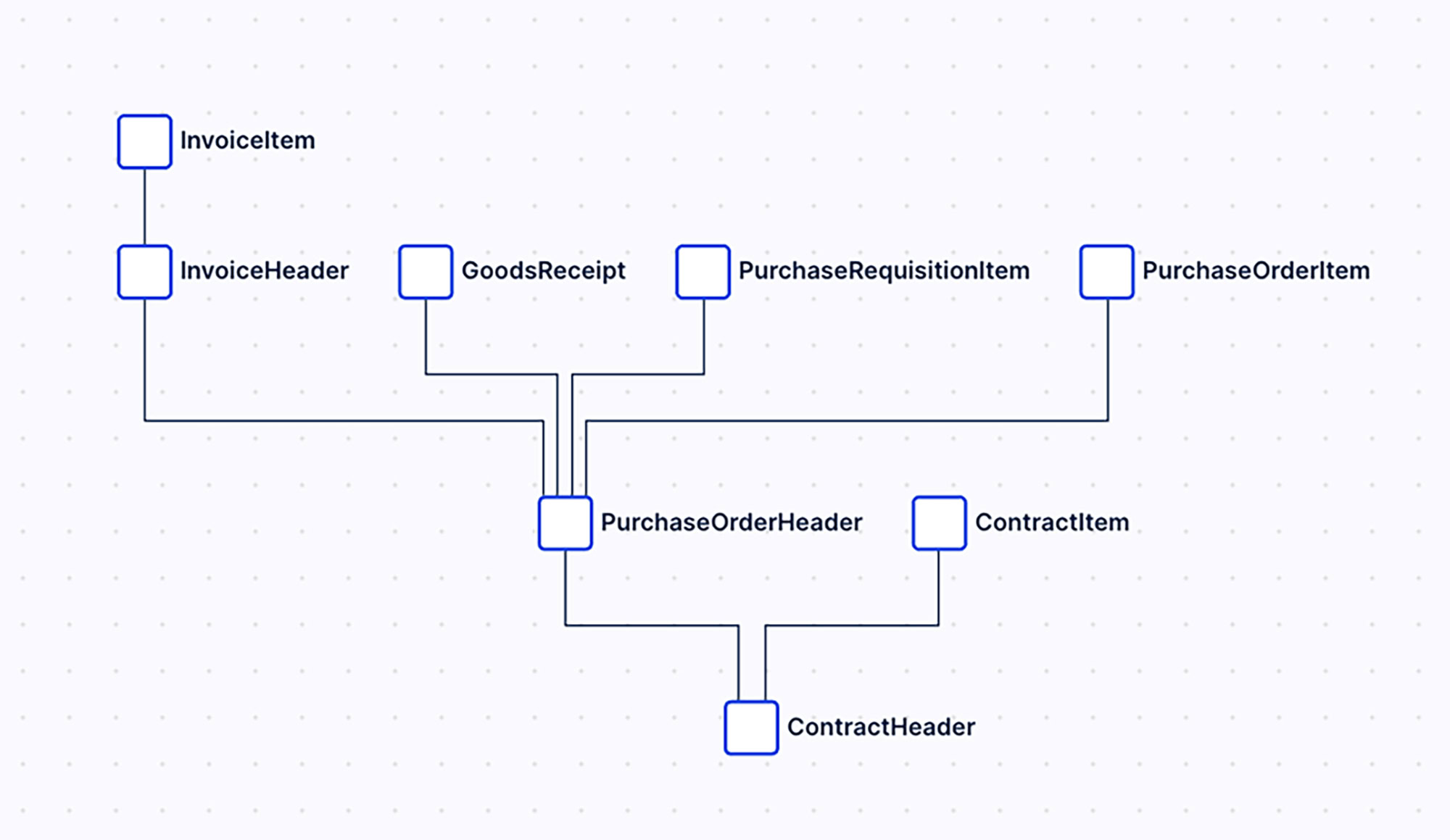
Figure 1: Defining object relationships
Why does this matter?
When organisations analyse processes through objects rather than a single process flow, they gain deeper insights into dependencies and bottlenecks. However, one of the most powerful aspects of OCPM is the ability to explore the same process from different object perspectives.
For example, a procurement manager may focus on the purchase order perspective to understand ordering efficiency and supplier performance. A finance specialist may instead analyze the process from the invoice perspective to identify payment delays and invoice matching issues. Similarly, a contract manager can follow the contract perspective to understand how contractual agreements influence downstream procurement activities.
Because all these objects remain connected within the same model, stakeholders can investigate the process through their own lens while still understanding how their area interacts with the broader procure-to-pay process.
This enables more accurate root-cause analysis, improves transparency and supports better decision-making. OCPM helps organizations move beyond activity tracking and understand the relationships that drive process performance.
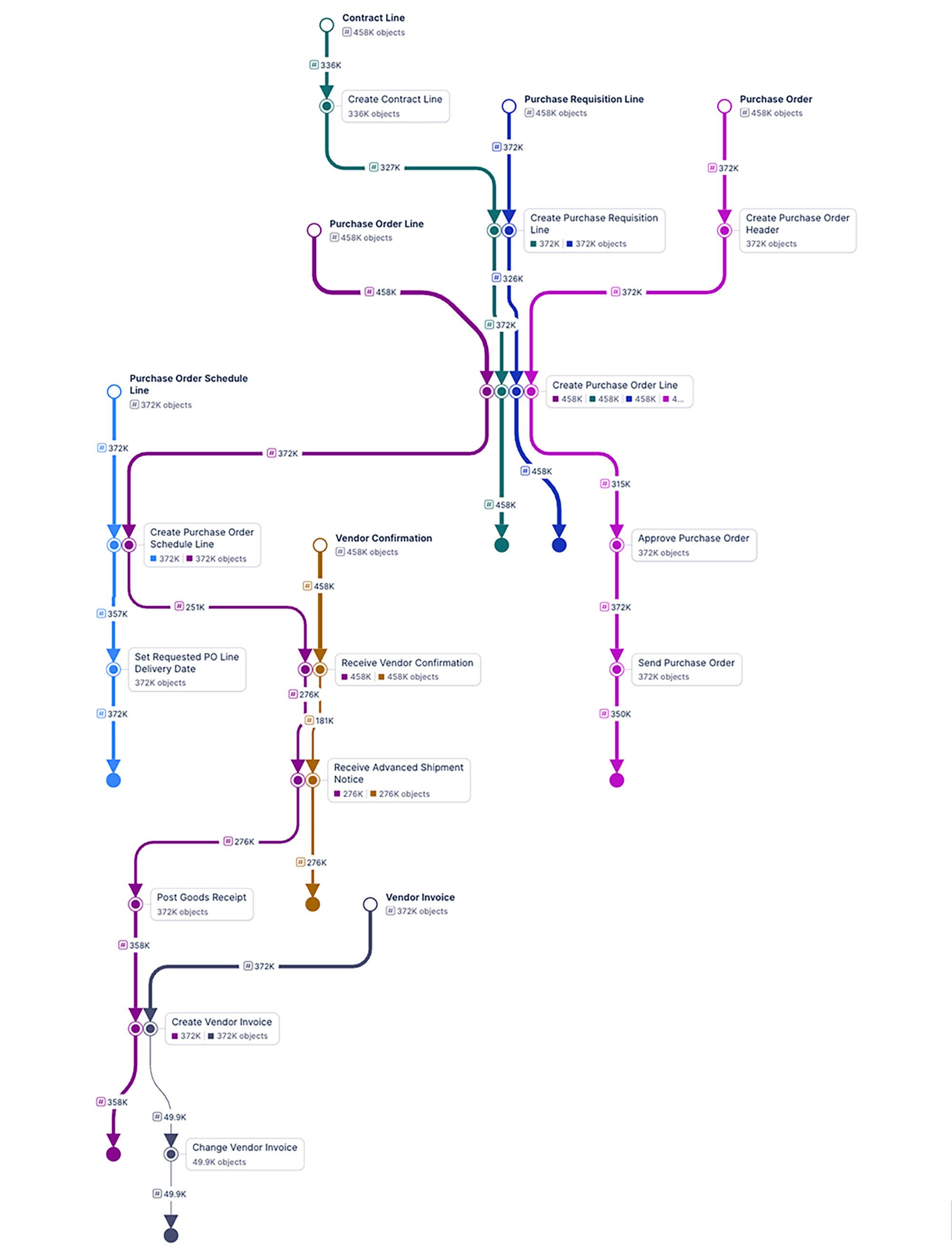
Figure 2: P2P process discovery
This object-centric view allows organizations to move beyond simple activity sequences and understand how process performance is influenced by relationships between business objects. As a result, bottlenecks, compliance issues, and process inefficiencies can be identified with greater accuracy than in traditional process mining.
Author

Ayse Nurperi Ozgen
Business Process Consultant, Solita
Ayse Nurperi specializes in process intelligence, process mining, and business process transformation. She has helped organizations analyze and optimize their processes using leading platforms such as Celonis and SAP Signavio, combined with modern process intelligence methodologies. She is passionate about uncovering process insights, simplifying complexity, and enabling data-driven business decisions